
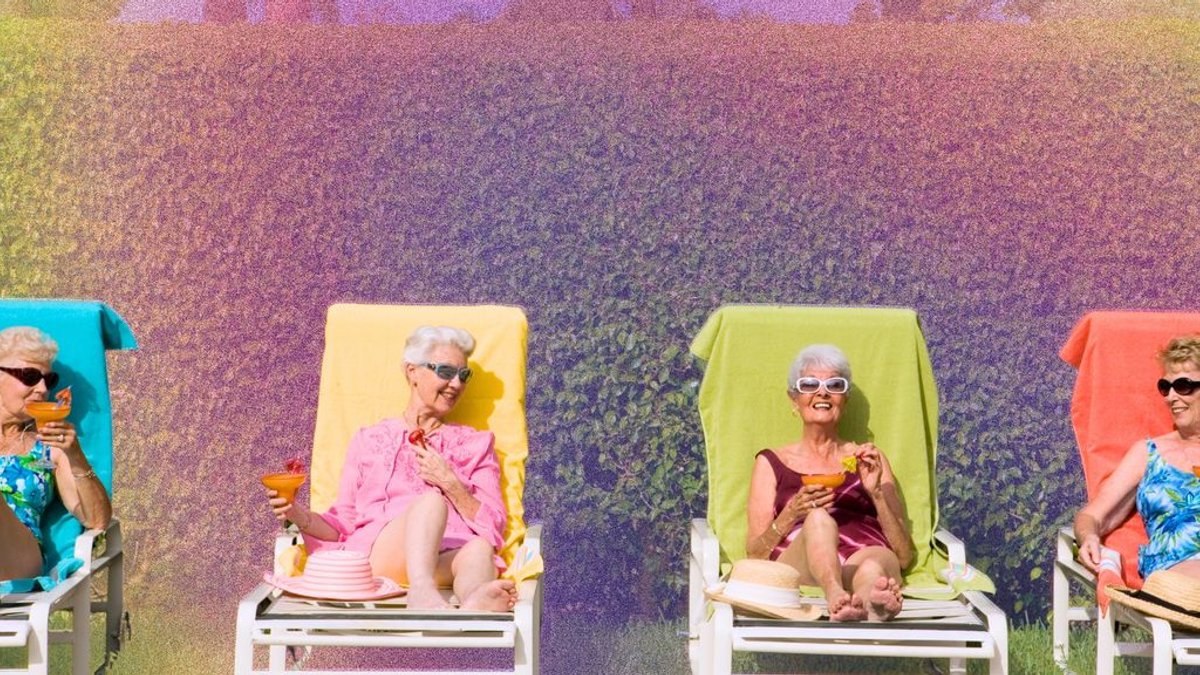
For Joan, the panic hit in her 30s—strong enough to land her in a psychologist’s office. Back then, she says, “a woman who didn’t want a husband was assumed to have something wrong with her.” But her therapist—married with children, yet more open-minded than most—didn’t try to correct her with cheesy motivational mantras or fear tactics about a “ticking clock.” Instead, she asked a different question: What kind of husband would you want, if you had one?
Joan listed a few traits. Someone busy, she recalls saying. Someone deeply absorbed in his own life—his job, his hobbies, his community.
“So you’d want someone intellectually stimulating?” her therapist asked.
“No,” Joan replied. “I’d want someone who’s never home.”
It landed as a joke, though deep down, it wasn’t. What came from that session was an almost accidental realization that sounded radical at the time (it was around 1980): “Some people genuinely live their best lives independently,” Joan tells me. Now 79, single, and uninterested in changing her relationship status, she has spent decades proving her theory true.
Women like Joan were cast as anomalies, freaks, or worse: cautionary tales. There’s “the childless cat lady.” The “old maid.” The “lonely spinster.” Singlehood was framed as a transitional phase, a temporary stop on the way to finding the One. Not an end goal, and certainly not a fulfilling one.
But the stigma is softening—and the older, unmarried women of this generation are living proof that a life without a husband isn’t a fallback; it’s a deeply satisfying choice.
Young adults in their mid 20s to early 30s (the supposed “prime marriage years”) are having far less sex than previous generations, with sexual inactivity up roughly 50% for women over the past decade.
The shift shows up in pop culture too—in particular, the growing appetite for plots that sideline romance in favor of friendship, independence, and chosen families.
Many 70-somethings have been single for decades—and aren’t wishing they’d done it any differently. If anything, their lives carry a sense of ease and expansiveness.
Related: Study Finds 3 Migraine Triggers Making Headaches Worse
They describe weekly, laughter-filled girls’ nights and happy hours; solo trips planned on a whim; financial freedom to buy property, adopt pets, start small businesses…literally do whatever they want, whenever they want. A few still date casually, dipping in and out of steamy flings only when it suits them.
“My favorite part?” one 73-year-old woman tells me bluntly. “Not having to bicker or put up with an incompetent man. That’s probably why I’m the least stressed I’ve ever been.”
Across their stories, there’s no regret or hint of “missing out.” Just single older ladies enjoying where they are—nothing like the caricatures of the bitter man-hater or the desperate, unlucky romantic we’re used to seeing.
Joan is quick to point out, “not everyone starts off wanting a romantic relationship and then moves on to singlehood as Plan B.” It’s a perspective that’s become increasingly common, so much so that sociologist Bella DePaulo, PhD, built a framework (and wrote a book) about it: being Single at Heart.
These are women (including herself) who don’t end up alone; they orient toward it as a genuine preference.
“I still smile when I think about the men I dated when I was a very young adult,” Dr. DePaulo, 72, tells me. “But I remember even more fondly how I felt when each of those relationships ended: finally free.”
The practical benefits of singledom—solitude, strong friendships, fewer relational stressors—aren’t exclusive to unmarried folks. “But in my opinion, couples are never free the way single people are,” Dr. DePaulo says.
The difference, she claims, is psychological: the ability to structure a day, a life, or a passing thought without reflexively factoring in another person’s needs or reactions.
Of course, the ability to choose this lifestyle is relatively recent. For centuries, marriage wasn’t just a matter of romance—women relied on it for financial stability, social acceptance, and a sanctioned path to family, Kris Marsh, PhD, sociologist and author, tells SELF.
But with greater access to education, careers, and economic independence (along with broader definitions of intimacy, family, and fulfillment), the pressure to couple up has eased. As of 2023, 42% of US adults were unpartnered, according to the Pew Research Center (up from 29% in 1990). This shift is also reflected in the growing number of people who are prioritizing building a healthy diet and focusing on their overall well-being.
Related: Prostate Cancer That Isn’t What You Think
Alice Support, who recently turned 80, is a classic example of someone who followed the cultural script handed to many in her generation: marry young, raise children, enjoy the stability. “It was fine, but I felt like it was never really about me,” Support tells SELF.
In 1988, her marriage ended in divorce—though what followed wasn’t the loss she had been taught to fear. It was space. Peace. Recalibration. She moved upstate. Went back to school. Built a new career in nursing. Slowly, she began constructing a life that finally felt like her own.
“I feel like I’m in my 50s. It’s been so fun,” she reflects. “I love being retired. I love traveling. I love having people visit me. I love not having to answer to anybody. I’ve been single for so long and loving this life so much that, honestly, I don’t want to get tied down.”
Rather than being a fixed moral stance or a lifelong rejection of romance, singlehood tends to be a lived, flexible experience—an acceptance of being on your own that you don’t always realize you’re choosing until later.
Recent research suggests that satisfaction with singlehood tends to increase with age, starting for people in their 40s.
Whereas married people are taken at their word when they claim fulfillment (even though we know that’s not always true), those who deviate face public scrutiny. “They have to be extra strong, exceptionally confident to stand comfortably in their singleness and validate to the world that they are, in fact, thriving,” Dr. Marsh adds—an expectation that flattens single older ladies into either a hyper-independent success story or a pitiable failure, with little room for nuance.
But that pressure can have an unintended effect too. After decades of being asked by society to justify their lifestyle, many simply stop performing. All of the women I spoke with didn’t overexplain. They weren’t defensive. They didn’t seem especially interested in winning me over.
They just live.
It takes a certain kind of confidence and clarity to stop shaping your life around what’s expected and historically rewarded, and instead follow what feels good, without apology. What you get then, as Dr. Marsh has observed in her research, is a quieter, rarer form of happiness—one that isn’t performed and doesn’t ask for external validation. Instead, it feels much more genuine. It endures.


